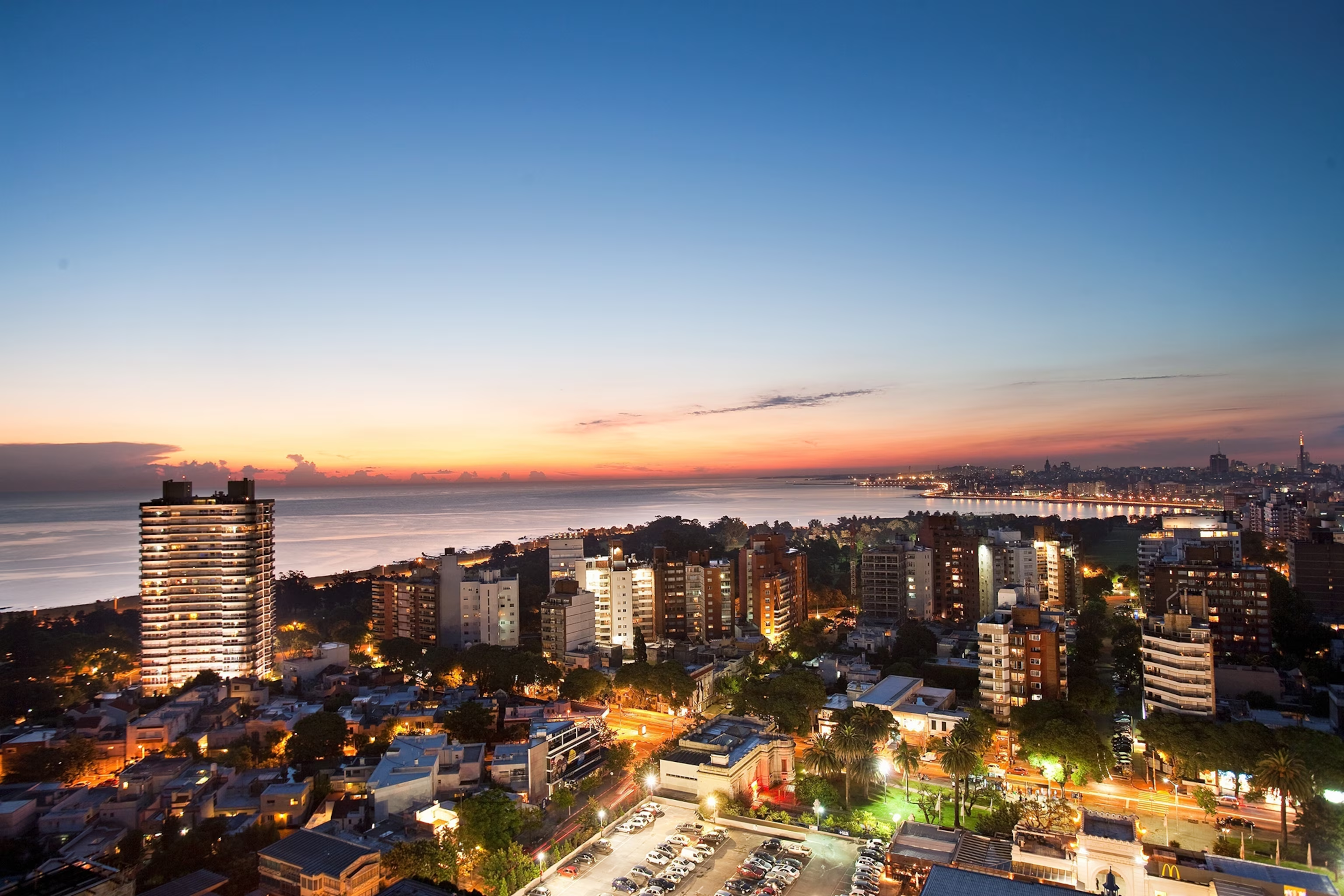
As South America’s most politically stable, dollarized property market enters 2027, Uruguay is consolidating after a strong 2025–2026 expansion into a steady, income-oriented phase. Following annual US dollar price gains of 5.1% in Montevideo and 9.3% in Maldonado (Punta del Este) through 2026—bolstered by Argentine and Brazilian wealth inflows, North American and European lifestyle relocations, and Uruguay’s Vivienda Promovida (Promoted Housing) tax-incentive program—2027 is projected to deliver 3% to 6% nominal USD appreciation.
Because Uruguayan real estate is priced and transacted almost entirely in US dollars while local salaries and building expenses are denominated in pesos, international buyers enjoy built-in currency protection alongside a predictable legal system. However, with total round-trip transaction costs running roughly 13% to 15% and new luxury supply arriving along the coast, 2027 rewards a five-year-plus holding horizon, disciplined price negotiation, and micro-markets with year-round tenant demand.
Key Market Trends Shaping Uruguay in 2027
-
Modest USD Price Growth & Negotiation Leverage (3% – 6%): With local household incomes capping how rapidly mid-market prices can climb and Uruguay’s Central Bank (BCU) holding its policy rate near 6.0% to contain inflation around 4.7%, broad price growth will remain measured. Cash buyers regularly negotiate 8% to 12% discounts on resale listings that have lingered on the market.
-
Punta del Este’s Transition to a Year-Round Market: Once strictly a three-month summer resort, Punta del Este and neighboring Maldonado are seeing full-time resident growth, international school expansion, and branded hospitality investments (such as the $500 million Fasano Peninsula redevelopment). Still, because average annual short-term occupancy hovers around 35% to 45%, investors in 2027 are underwriting annual leases rather than relying solely on peak January summer rents.
-
Continued Momentum in Vivienda Promovida (Law 18.795) Developments: Government-backed promoted housing projects—spanning Montevideo, Canelones, and Maldonado—continue to attract yield-focused investors thanks to 10-year exemptions on rental income tax and wealth tax, with developer construction loan guarantees extended through the end of 2027.
-
Updated Tax-Holiday Rules for New Tax Residents: Under Law 20.446, foreign nationals establishing tax residency in Uruguay face a 12% tax on foreign-source passive income unless they elect Uruguay’s updated Tax Holiday option (11 years at 0%, followed by 5 years at 6%)—keeping Uruguay highly competitive for retiring or remote-working international buyers.
The Best Places to Invest in Uruguay in 2027
Uruguay’s real estate opportunities center on four distinct corridors spanning the Río de la Plata and the Atlantic coastline:
1. Montevideo Coastal Barrios (Pocitos, Punta Carretas, Carrasco & Buceo)
Montevideo’s eastern waterfront neighborhoods represent the gold standard for liquidity, walkability, and capital preservation. Pocitos and Punta Carretas offer the deepest year-round rental market for professionals and expats, while leafy Carrasco leads the country’s luxury detached-house and diplomatic segment.
2. Montevideo Central & Promoted-Housing Zones (Cordón, Centro & La Blanqueada)
For investors prioritizing net rental yield and tax efficiency, central districts approved under the Promoted Housing Law deliver modern one- and two-bedroom apartments with lower entry prices and 5.5% to 6.3% gross yields.
3. Punta del Este, La Barra & José Ignacio (Maldonado)
Ultra-prime beachfront towers along Playa Brava and boutique estates in José Ignacio have pushed top new-build prices toward $6,000–$9,000/m². While entry-level luxury stock faces healthy competition from new deliveries, scarcity-backed oceanfront residences and year-round hubs like Península, Roosevelt, and La Barra remain premier wealth-preservation plays.
4. Canelones Coast & Colonia del Sacramento
Driven by spillover from eastern Montevideo and Carrasco, coastal Canelones (Ciudad de la Costa) recorded 11.1% year-on-year price growth and a 29% surge in new project starts heading into 2027. Further west, UNESCO-listed Colonia del Sacramento—just an hour by ferry from Buenos Aires—continues to draw weekend-home and boutique hospitality buyers.
2027 Regional Price & Rental Yield Snapshot
| Region / Neighborhood | Typical Entry Price (USD) | Avg. Price per m² | Target Gross Rental Yield | Primary 2027 Investment Driver |
| Montevideo Prime Coast (Pocitos / Punta Carretas / Carrasco) | $220,000 – $1,500,000+ | $3,200 – $5,200 | 4.5% – 5.8% | Highest national resale liquidity & steady expat/corporate demand |
| Montevideo Central & Promoted Zones (Cordón / Centro / La Blanqueada) | $115,000 – $260,000 | $2,350 – $3,100 | 5.5% – 6.4% | 10-year Vivienda Promovida tax exemptions & student/worker demand |
| Ciudad de la Costa (Canelones) | $160,000 – $550,000 | $2,600 – $3,400 | 5.0% – 6.2% | Suburban family migration from Montevideo & rapid project expansion |
| Punta del Este & Maldonado (Playa Brava / Mansa / Península) | $220,000 – $3,500,000+ | $2,800 – $8,500+ | 5.5% – 7.8% | Year-round residency shift, regional wealth inflows & branded developments |
| La Barra & José Ignacio | $450,000 – $5,000,000+ | $4,000 – $9,000+ | 4.5% – 6.5% | Ultra-prime coastal scarcity & international lifestyle buyers |
| Colonia del Sacramento | $130,000 – $480,000 | $2,000 – $2,750 | 5.2% – 6.8% | Buenos Aires ferry proximity, historic charm & weekend tourism |
Taxes, Closing Costs & Foreign Buyer Rules for 2027
Uruguay guarantees equal constitutional property rights for domestic and international buyers, backed by a secure, notary-led title system:
-
100% Open Foreign Ownership: Foreign individuals and foreign companies can buy freehold urban, coastal, and rural property in Uruguay with no residency requirement, no special permits, and no ownership caps. (Note: Strict anti-money-laundering rules require documented proof of source of funds wired to your notary’s escrow account.)
-
Buyer Closing Costs (~6% – 9% Total):
-
Property Transfer Tax (ITP): 2% of the property’s cadastral (fiscal) value—split 1% paid by the buyer and 1% paid by the seller.
-
Notary (Escribano) Fees: Typically 3% + 22% VAT of the purchase price (the escribano conducts full 30-year title due diligence and registers the deed).
-
Registry, Certificates & Agency Commission: Public deed registration and municipal certificates add roughly 0.5% to 1.0% ($200–$500 for certificates plus registry fees), while real estate agency commission is standardly 3% + 22% VAT per side.
-
-
Rental Income & Capital Gains Taxes: Standard rental income is taxed at a flat 12% on gross rent for both residents and non-residents (unless exempt under a Vivienda Promovida new-build project). Capital gains on property resales are taxed at 12% on the inflation-adjusted profit.
-
Ongoing Carrying Costs & Residency: Owners pay an annual municipal property tax (Contribución Inmobiliaria, typically $500–$2,000/year for a standard apartment), monthly building maintenance fees (gastos comunes, $100–$500/month), and an annual Wealth Tax (Impuesto al Patrimonio) only if net Uruguayan assets exceed statutory thresholds (~$155,000+ for individuals, adjusted annually). Legal residency is straightforward and requires proof of roughly $1,000 to $1,500/month in stable income rather than a minimum real estate spend.
Investor Takeaway for 2027
Uruguay is built for capital preservation, USD-denominated stability, and steady rental income rather than quick speculative flips. In 2027, focus on liquid coastal neighborhoods in Montevideo (Pocitos/Punta Carretas), tax-exempt Vivienda Promovida new builds, or year-round residential pockets in Punta del Este—and always factor monthly gastos comunes into your net yield calculations.
Thinking of buying or selling a home, apartment, or coastal estate in Uruguay? Contact the eSales International team to market your property to global buyers or explore vetted opportunities in Montevideo and Punta del Este.